
Accounting Time and Billing Software FAQ: Should the Partner do the Billing?

The Traditional Approach to Time and Billing Software
Effective use of time and billing software should always involve the billing partner for best results. Many accounting firms follow traditional billing patterns. For example, (1.) the distribution of detailed work in progress reports to the individual partners or owner as the first step in the billing process. (2.) the partners or owner analyze the work in progress reports and sometimes request copies of prior invoices, or analysis reports to determine client profitability or delinquency.
(3.) The partners or owner make notes and billing instructions on the work in progress reports and return them to the administrative staff for invoice preparation. (4.) Drafts of invoices are printed and (5.) submitted to the partners or owner for review and changes. (6.) Corrections and edits to the invoices are made by the staff. (7.) Partners or owners perform a final review of the edits and changes. (8.) The invoices are mailed or emailed to the clients.
The whole process takes at least eight steps and can be very time-consuming involving a significant amount of redundant effort.
“New Age” Time and Billing Software
Today many practitioners demand that time and billing software allow them to directly access their work in progress and prepare invoices from their workstation. The most obvious savings are the elimination of the middleman or administrative staff which reduces the overall time spent preparing client invoices.
Furthermore, the partner or owner is working directly with the data. Eliminate unnecessary edits or drafts: just review the text and amounts and mail the invoice. Oftentimes, the owner when working directly with the data in this manner will think of additional opportunities for value billing, or better ways to express the service. It’s more difficult for the administrative assistant to ‘get it right’ when expressing the nature of the service from written notes on a copy of the work in progress report. An owner can oftentimes better discern the most appropriate vernacular for a client invoice because of the direct personal relationship.
In situations where partners prepare their own invoices, the firm might have some procedure they follow for accountability. For example, invoiced realization reports that show amounts billed compared to slips at standard rates. Also, aging of total unbilled work in progress by partner reveals situations that require further attention by firm management. Partners not involved with invoice preparation should review both invoices and pending invoice reports before final posting.
Of course in certain cases, such as fixed-fee recurring, monthly bills, it may not be necessary to involve the partner. Administrative staff should handle any repetitive process not requiring significant alterations.
The Compromise
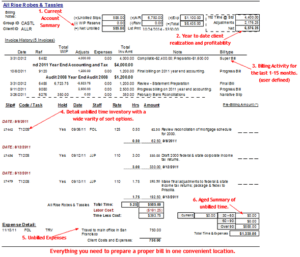
At a minimum, your billing system’s work in progress report should display the comprehensive information necessary for invoice preparation. It’s a waste to time for staff to search files for last months supporting documents and invoice copies. In addition to the showing time entries, the work in progress report should provide prior invoice information. It should also show current year write-ups, write-downs as well as account receivable aging information. Mango software generated the following work in progress report:
Latest Posts

QuickBooks Time Tracking for Accounting Firms: What Breaks at 10+ Staff (and What to Do About It)
Most firms eventually outgrow basic tools, but hitting 10+ staff usually exposes the limits of general-purpose timekeeping. Learn when your firm needs specialized time tracking software for accountants to manage complex rates, detailed client matters, and reporting.

The CAS Pricing Problem: Structuring Monthly Recurring Revenue Without Scope Creep
Client Advisory Services (CAS) can look profitable on paper while scope creep drains margins. Learn how to structure CAS pricing, build tiered service models, and manage change orders to protect your accounting firm’s monthly recurring revenue.

Why Tax Season Workflows Break (Even When You Have Software): A Bottleneck Audit for CPA Firms
Tax season puts immense pressure on operations, turning small friction points into serious delivery issues. Learn how to perform a post-season bottleneck audit to evaluate document collection, capacity planning, and handoffs, and discover the practical steps required to optimize your CPA firm workflow management before the next busy season hits.

When to Stop Billing Hourly: The Accounting Firm’s Transition Playbook to Value-Based Pricing
Moving away from hourly billing requires a clear strategy. Learn how to safely implement accounting firm value-based pricing with our 6-phase playbook, designed to protect your margins, manage staff capacity, and eliminate scope creep.

How to Say No: 7 Scripts to Protect Your Time, Team, and Clients
Unchecked client demands exhaust your staff and compress delivery margins. Learn how accountants can say no through structured, repeatable communication scripts.