
An Essential Guide to Pricing Client Accounting Services

Are You Overpaying for Tax Software? A Cost Per Return Breakdown for Small Firms
Most firms know what they pay for tax software.
Fewer know what they pay per return.
That number is what actually determines profitability.
If your tax software pricing looks reasonable on paper but your margins feel tight, the issue may be hidden in how your costs scale. This guide breaks down how to calculate your true cost per return, uncover hidden accounting software costs, and identify where you may be overpaying.
Why Tax Software Pricing Alone Does Not Tell the Full Story
Sticker price is only part of the equation.
Two firms can pay the same for tax software and have completely different profit outcomes.
Why?
Because tax software pricing does not account for:
- Time spent managing disconnected tools
- Staff inefficiencies during peak season
- Delays in billing and collections
- Manual work outside the tax platform
The real question is not “What does your software cost?”
It is “What does it cost to complete one return?”
How to Calculate Your True Cost Per Return
Start with a simple formula:
Total Software + Labor + Overhead ÷ Number of Returns = Cost Per Return
Break it down further:
1. Direct Tax Software Pricing
Include:
- Annual licensing fees
- Per-return fees
- Add-ons or modules
This is your baseline tax software pricing.
2. Hidden Accounting Software Costs
This is where most firms underestimate.
Include:
- Workflow or project management tools
- Document storage and eSignature platforms
- Client portals or file-sharing tools
- Time tracking and billing systems
If you are using multiple tools to run your firm, those are all part of your accounting software costs.
3. Labor Cost Per Return
Estimate:
- Average time spent per return
- Hourly cost of staff involved
Even small inefficiencies add up quickly across hundreds of returns.
4. Revenue Leakage and Delays
Often overlooked, but critical:
- Unbilled time
- Delayed invoicing
- Slow client payments
These directly increase your effective cost per return.
What a Healthy Cost Per Return Looks Like
There is no universal benchmark, but strong firms tend to:
- Keep software costs predictable and scalable
- Minimize manual work outside tax prep
- Invoice immediately after completion
- Maintain consistent turnaround times
If your cost per return fluctuates wildly or increases during busy season, that is a warning sign.
Common Signs You Are Overpaying for Tax Software
You may not be overpaying on price. You may be overpaying in process.
Watch for these signals:
- You need multiple tools just to complete one return
- Staff spend time searching for documents or updates
- Billing is disconnected from the work being done
- You cannot clearly track profitability per client
These are not just workflow issues. They are cost drivers.
Stop Scope Creep in Its Tracks
Mango Practice can help you prevent scope creep and deliver exceptional CAS. Our platform streamlines project management, enhances communication, and automates workflows, ensuring your projects stay on track and within budget.
The Real Problem: Fragmented Systems Drive Up Costs
Here is where most firms lose margin.
Your tax software handles preparation. But everything around it lives elsewhere:
- Tasks in spreadsheets
- Documents in email or shared drives
- Client communication scattered
- Billing handled separately
That fragmentation increases:
- Time per return
- Error rates
- Administrative overhead
And ultimately, your total accounting software costs.
How to Reduce Cost Per Return Without Switching Tax Software
You do not always need new tax software.
You need a better system around it.
To lower your cost per return:
- Standardize workflows across engagements
- Centralize documents and communication
- Automate task tracking and reminders
- Connect time tracking directly to billing
- Reduce the number of tools your team uses daily
The goal is simple: fewer steps, fewer systems, less wasted time.
Where Mango Fits: Reducing Total Accounting Software Costs
This is where firms start to see real savings.
Mango does not replace your tax software. It makes everything around it more efficient.
With Mango, you can:
- Manage tasks, deadlines, and workflows in one place
- Store and share documents securely without switching tools
- Track time and generate invoices directly from work completed
- Centralize client communication and follow-ups
- Monitor profitability and performance in real time
Instead of stacking multiple subscriptions, Mango helps consolidate your accounting software costs into a single system.
That means:
- Less time switching between tools
- Fewer missed billable moments
- Faster invoicing and payments
Everything accountants need, all in one place.
Quick Self-Assessment: Are You Overpaying?
Ask yourself:
- Do I know my exact cost per return?
- How many tools does my team use to complete one return?
- How much time is spent on non-billable admin work?
- Are we billing immediately after work is completed?
If you cannot answer these quickly, there is likely hidden cost in your system.
Take Control of Your Cost Per Return
You do not need to guess where your margins are going.
By understanding your true cost per return and reducing unnecessary accounting software costs, you can improve profitability without increasing workload.
Start your free 10-day trial of Mango Practice Management and simplify the systems behind every return.
Take Your CAS to the Next Level
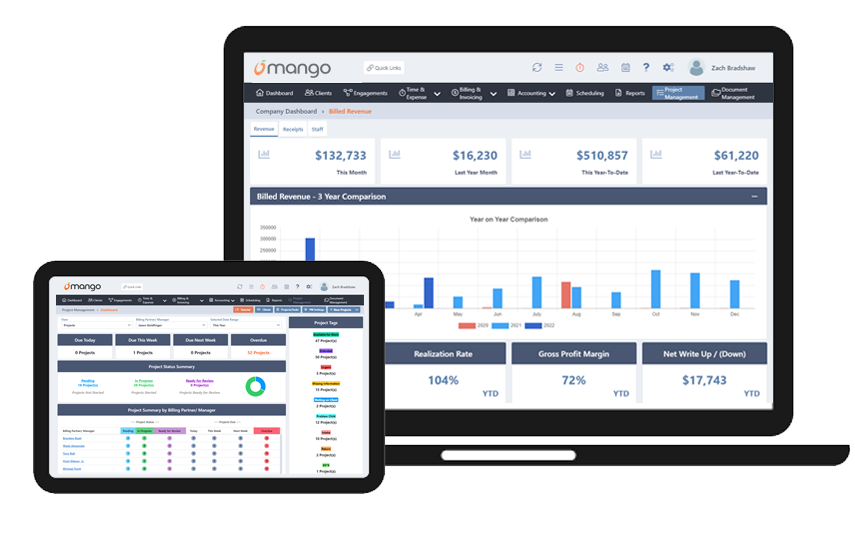
Mango Practice Management has everything you need to make pricing easier, keep communication flowing, and amp up your firm’s efficiency.
Latest Posts

QuickBooks Time Tracking for Accounting Firms: What Breaks at 10+ Staff (and What to Do About It)
Most firms eventually outgrow basic tools, but hitting 10+ staff usually exposes the limits of general-purpose timekeeping. Learn when your firm needs specialized time tracking software for accountants to manage complex rates, detailed client matters, and reporting.

The CAS Pricing Problem: Structuring Monthly Recurring Revenue Without Scope Creep
Client Advisory Services (CAS) can look profitable on paper while scope creep drains margins. Learn how to structure CAS pricing, build tiered service models, and manage change orders to protect your accounting firm’s monthly recurring revenue.

Why Tax Season Workflows Break (Even When You Have Software): A Bottleneck Audit for CPA Firms
Tax season puts immense pressure on operations, turning small friction points into serious delivery issues. Learn how to perform a post-season bottleneck audit to evaluate document collection, capacity planning, and handoffs, and discover the practical steps required to optimize your CPA firm workflow management before the next busy season hits.

When to Stop Billing Hourly: The Accounting Firm’s Transition Playbook to Value-Based Pricing
Moving away from hourly billing requires a clear strategy. Learn how to safely implement accounting firm value-based pricing with our 6-phase playbook, designed to protect your margins, manage staff capacity, and eliminate scope creep.

How to Say No: 7 Scripts to Protect Your Time, Team, and Clients
Unchecked client demands exhaust your staff and compress delivery margins. Learn how accountants can say no through structured, repeatable communication scripts.